

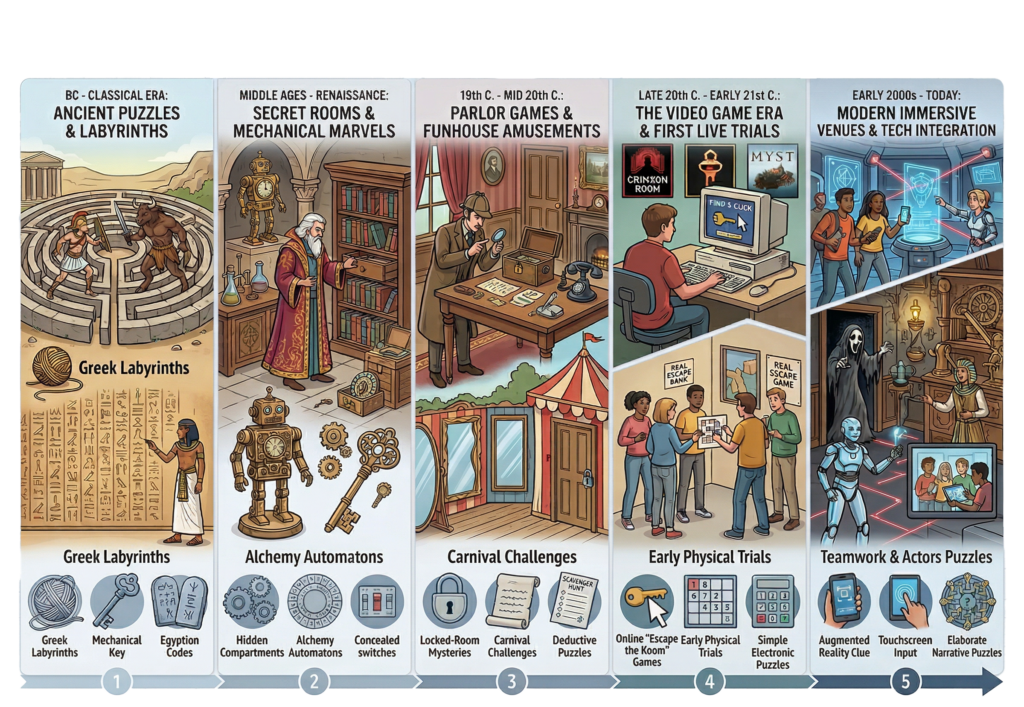
Ask five escape room veterans where it all started, and you will get five different answers. Japan. Hungary. Spain. The internet. A university physics classroom in Switzerland. The origin of escape rooms is one of the most debated questions in the industry — and the honest answer is that all of them are right, in their own way.
This article traces the full timeline of escape room history: the digital ancestors that planted the seed, the visionaries across three continents who first dared to lock strangers in a room, the cities that defined the art form, and the international brands — most prominently PanIQ Room — who transformed a grassroots novelty into a structured global industry.
Before the Rooms: The Digital Ancestors
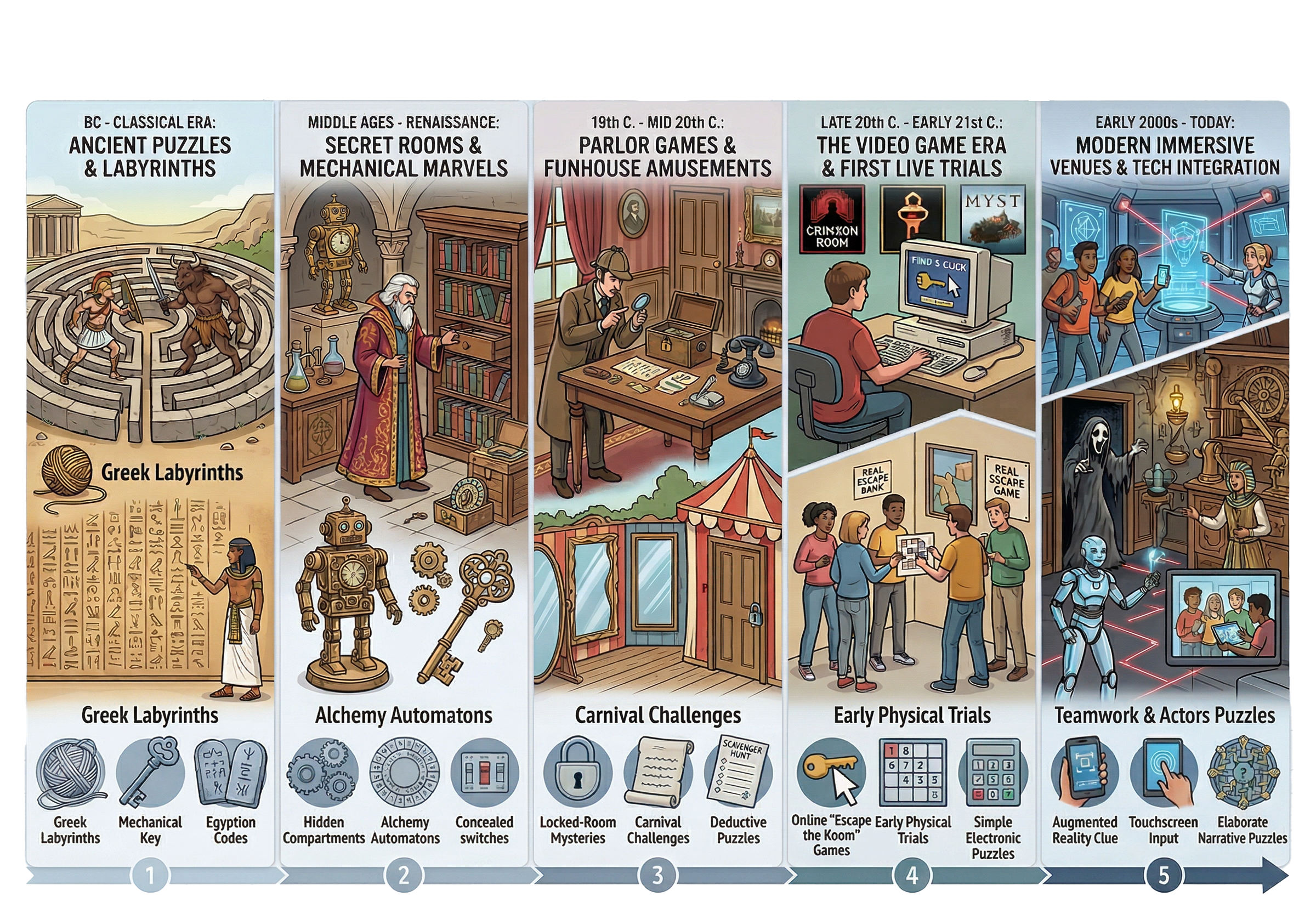
To understand where escape rooms came from, you have to look at screens before you look at walls. The intellectual DNA of every escape room traces back to a genre of video game that emerged in the 1980s: the point-and-click puzzle adventure. These games asked one persistent question — how do you get out of here?
The 1993 releases of Myst and The 7th Guest brought atmospheric puzzle-solving to mainstream PC gaming. But the most direct ancestor came in 2004, when Japanese developer Toshimitsu Takagi released Crimson Room online — a free browser game set in a single locked room, requiring players to find 23 hidden clues to escape. It spread virally across Japan and sparked what became known as “Takagism,” a genre obsession with escape-the-room puzzles.
At roughly the same time, British television was airing The Crystal Maze (1990) — a show that placed contestants in timed, puzzle-filled chambers. The ingredients were already in the cultural air. Someone just needed to make them physical.
Harry Houdini — the world’s most famous escape artist — was Hungarian-born. Budapest’s Parapark named its difficulty scale the “Houdini Scale” in his honor, a detail that feels less like coincidence and more like destiny.
Japan, 2007: The First Real Room
The first documented physical escape room in history opened in Kyoto, Japan, in July 2007. Its creator was Takao Kato, founder of SCRAP Co., a Kyoto-based publishing company. Kato’s inspiration came from watching a classmate play an online escape-the-room game. The first events were not fixed venues — they were live experiences hosted in clubs and bars, with teams of five or six players buying tickets in advance. Those tickets sold out immediately.
SCRAP’s games were logic-forward: mathematical sequences, color codes, cryptographic clues — faithful translations of the video game format into physical space. By the early 2010s, the format had expanded into dedicated venues across Japan, then Singapore and Australia. In 2012 the concept arrived in San Francisco — the format’s first crossing into the Western hemisphere.
Japan’s claim to the title of “birthplace” rests on one thing: documentation. SCRAP’s 2007 event is the earliest dated, named, verifiable example of a physical real-life escape room.
Budapest, 2011: The City That Ran With It
If Japan lit the fuse, Budapest detonated the explosion. In early 2011, Hungarian entrepreneur Attila Gyurkovics opened Parapark in Budapest — and crucially, he claims to have done so with no knowledge of Kato’s Japanese rooms whatsoever.
Gyurkovics based his design not on video games but on the psychological concept of flow, developed by Hungarian-American psychologist Mihály Csíkszentmihályi — the state of complete absorption in a challenging task. Where Japan built logic puzzles, Budapest built narrative tension. Parapark’s rooms required players to find hidden keys, reach seemingly unattainable objects, and use their environment creatively under pressure.
The concept caught on with startling speed. Budapest — a city already renowned for puzzle culture (the Rubik’s Cube was invented there) and a dense, walkable urban fabric — became saturated with escape rooms. By the mid-2010s it had become one of the highest concentrations of escape rooms of any city on earth, earning its unofficial designation as the world capital of escape games.
“Many consider it a Hungarian invention — one of the most successful Hungarian exports of the 21st century.”

A Global Timeline: The Contenders
The history of escape rooms is not a straight line from one inventor to the world. It is a parallel story of independent discovery on multiple continents, converging into a global movement. Here are the key milestones.
Behind Closed Doors (1988), Myst (1993), and Takagi’s viral browser game Crimson Room (2004) establish the “escape the room” genre in gaming, giving millions of players fluency with the core mechanic before any physical room exists.
Spain
Differend Games opens La Máquina in Getafe (2003) and La Fuga in Madrid (2005) — live puzzle rooms predating Japan’s SCRAP events. Largely forgotten in mainstream narratives, their existence complicates any simple “Japan was first” claim.
Japan
Takao Kato launches the Real Escape Game for teams of 5–6 players in Kyoto. The concept spreads rapidly across Japan. SCRAP is the most widely cited “origin point” due to its documentation and direct influence on international expansion.
Budapest
Attila Gyurkovics opens Parapark reportedly with no knowledge of Japanese rooms. Based on Csíkszentmihályi’s flow theory, it pioneers the European model — physical search, hidden keys, narrative tension. Budapest’s escape room industry ignites almost overnight.
Budapest
Balázs Koltai opens Pániq Szoba — later to become PanIQ Room — in Budapest. The venue’s success seeds the first internationally franchised escape room chain in the world, eventually bringing Hungarian escape room craft to US and global audiences.
Switzerland
Physics teacher Gabriel Palacios creates a scientific escape game for students, later opening to the public as AdventureRooms and franchising across 20 countries. Infrared codes and polarized light puzzles introduce a new dimension to the genre.
USA
Nate Martin, a Microsoft alumnus, co-founds Puzzle Break in Seattle. By 2014 there are 22 escape rooms in the US. By 2019, over 2,300.
USA
Hungarian entrepreneurs including Ákos Gábossy and Patrik Horváth launch PanIQ Escape Room in Hollywood. San Francisco follows. The brand brings the European model of highly produced, narrative-driven rooms to American audiences at scale for the first time.
Global Franchise
PanIQ Escape Room becomes the world’s first brand to achieve full franchise disclosure documentation — transforming escape rooms from entrepreneurial pop-ups into a regulated, scalable business format. The industry never looks back.
Next Generation
Virtual reality, Gen3 production builds, and live actors redefine the format. PanIQ Room opens its Las Vegas Strip flagship in 2020; acquires 40% of Indestroom — the world’s largest escape room prop manufacturer — in 2022. Industry value exceeds $1 billion globally.
The Escape Room City Race: A Data Snapshot
The growth of escape rooms across major cities tells a story of viral adoption, cultural fit, and competitive density. Budapest exploded first; New York and London followed through mainstream adoption; Tokyo saw a slower domestic commercial build owing to SCRAP’s centralized event model.
New York
London
Tokyo
Los Angeles
Sources: Room Escape Artist, Wikipedia, Parapark history, industry surveys. Figures are approximate.
The Brands That Shaped the History
Ideas spread through people, and in the escape room industry, a handful of brands did more to shape the global landscape than any single trend. Here are the operators whose histories mirror the evolution of the form itself.
The brand that took Budapest’s escape room philosophy and franchised it globally. Founded in Hungary in 2012, expanded to the US in 2014, became the world’s first franchised escape room chain in 2017. Now operates 17+ locations across the US, Europe, and Asia — including a Las Vegas Strip flagship. Known for Gen3 production quality, immersive plots, and voice-acted game masters. Holds 40% of Indestroom, the world’s largest escape room prop manufacturer.
The originator. Takao Kato’s SCRAP Co. ran the world’s first documented escape room in 2007, pioneered the live-event format, and brought it to San Francisco in 2012. SCRAP’s influence is most visible in the puzzle-first design philosophy adopted by countless imitators.
The independent reinventor. Parapark launched Budapest’s escape room era with no Japanese influence, proving the concept could emerge naturally from the right cultural conditions. Eventually grew to 20 locations across Europe and Australia.
America’s first homegrown escape room company, founded by Microsoft alum Nate Martin. Puzzle Break proved the format could work for American audiences and laid the groundwork for the industry’s US explosion.
Began as a high school science class. Gabriel Palacios’s physics puzzles — hidden infrared codes, polarized light — opened the genre to STEM-driven design and became an international franchise in 20 countries.
One of Budapest’s first commercial operators, now a 48-room European network across 5 countries. Their original Csengery Street location still runs in collaboration with Parapark founder Attila Gyurkovics — the closest thing to a living museum of the form’s origins.
Why Budapest Won the Origin Argument
Here is the honest verdict: Japan was first, chronologically. But Budapest was the city that proved escape rooms could be a cultural institution, not just a novelty. The city had several advantages: a highly educated, puzzle-literate population; a dense walkable centre with cheap commercial real estate; a strong tourism base; and a cultural tradition of lateral thinking stretching from the Rubik’s Cube to the world’s most Nobel laureates per capita.
When Parapark opened, it opened a template. Dozens of Hungarian entrepreneurs followed within months. International visitors brought the format home to London, Moscow, Paris, and New York. Budapest did not invent the escape room — but it turned an experiment into an art form, and that is the more lasting contribution.
PanIQ Room is the commercial embodiment of that contribution. Born from Pániq Szoba in Budapest’s early rush, the brand spent three years refining its craft before taking the concept to Hollywood — then became the first operator in the world to formalize the franchise model.
From One Room in Kyoto to a Global Industry
In less than two decades, escape rooms moved from a single ticketed event in a Kyoto bar to an industry estimated at over $1 billion globally. They are now part of the corporate team-building toolkit at Google, Amazon, and Netflix. Virtual reality, branching narrative paths, live actors, and real-time environmental controls have pushed the format far beyond anything Takao Kato imagined in 2007.
But at the core, nothing has changed. Somewhere, right now, a group of strangers is locked in a room together, clock ticking, arguing about what a symbol means.
How do we get out of here?
FAQ: Origins of Escape Rooms
The most widely credited inventor is Takao Kato of SCRAP Co., who opened the first documented escape room in Kyoto, Japan, in July 2007. However, Attila Gyurkovics independently developed a nearly identical concept in Budapest in 2011, and earlier live puzzle experiences existed in Spain as far back as 2003.
Escape rooms have multiple independent origins. Japan is the primary birthplace by documentation. Budapest is recognized as the city that grew the concept into a cultural institution and exported it globally. Spain has a lesser-known prior claim through Differend Games in 2003.
PanIQ Room, founded from Budapest’s Pániq Szoba, became the world’s first escape room franchise with full disclosure documentation in 2017. It remains one of the largest and most widely distributed escape room chains globally.
Budapest grew the escape room concept faster and more densely than any other city, hosting over 100 distinct escape experiences in a city of under 2 million people. Its puzzle culture, walkable geography, and entrepreneurial energy made it the natural hub of the global movement.
The most influential digital ancestor is Crimson Room (2004) by Toshimitsu Takagi, which sparked the “escape the room” browser game genre. Earlier influences include Myst (1993) and text-based adventure games from the 1980s.
Find Escape Rooms Near You
Ready to step into a room and make your own history? Whether you’re chasing the Budapest experience or hunting for the best local venue, we’ve mapped every escape room near you.